Etihad Rail is one of the UAE’s most ambitious infrastructure projects. Designed to connect all seven emirates through a fast, modern, and efficient railway network, it will reshape how people travel, work, and choose where to live. For Dubai, the impact will be especially significant. The city is expected to become the central connection point of the entire network, creating new opportunities for residents, investors, and developers. This guide explores the Etihad Rail Dubai real estate impact, including how property prices, rental demand, and community growth are expected to evolve.
This guide explains how Etihad Rail will influence Dubai’s residential real estate market, which communities are likely to benefit the most, and what buyers should consider as the project moves closer to completion.
What Is Etihad Rail and Its Role in Dubai Real Estate
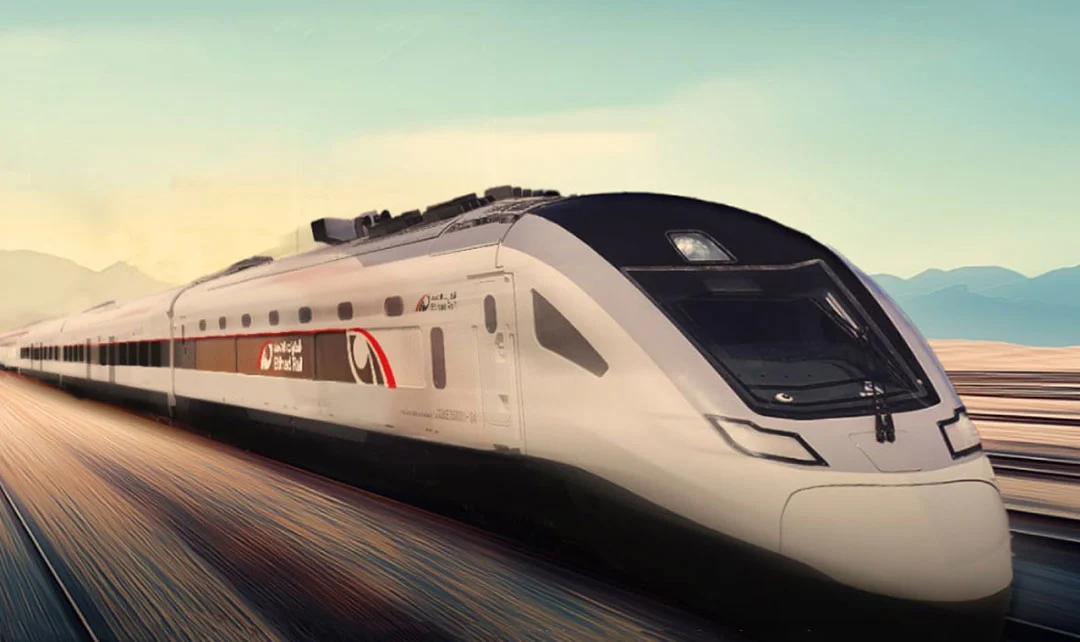
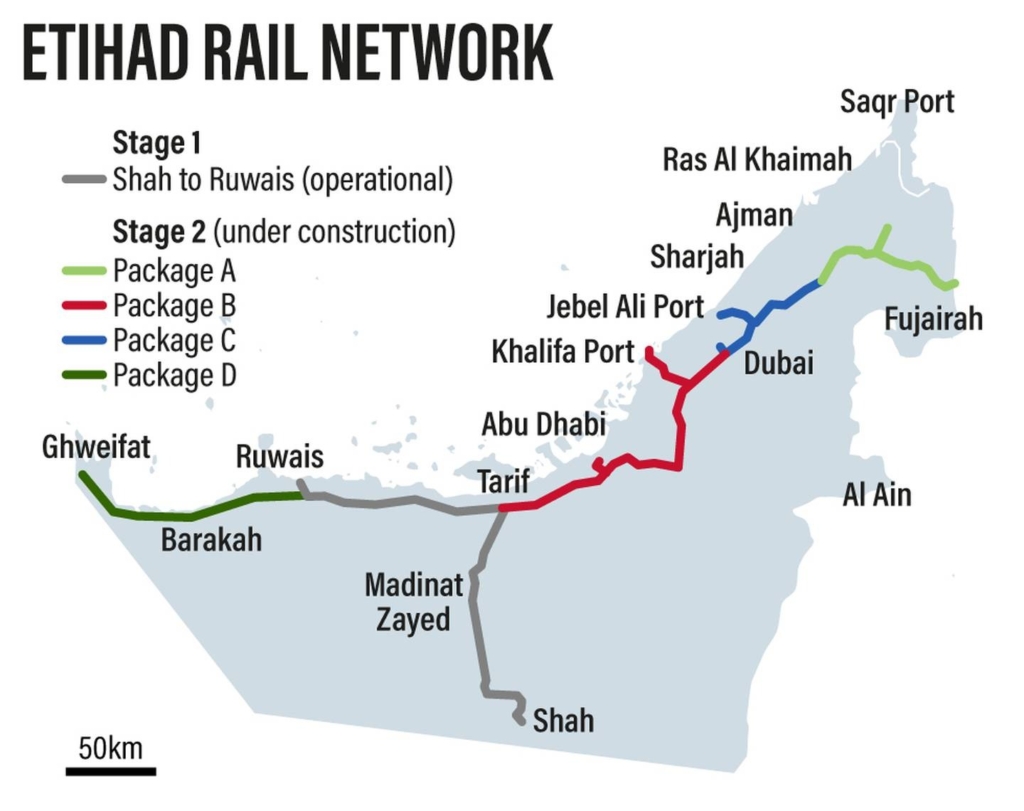
Etihad Rail is the UAE’s national railway network, designed to connect major cities, industrial hubs, and residential communities across the country. Built in phases, the network will eventually link the entire nation from east to west and north to south, creating a fast, reliable, and modern transport system for both passengers and freight.
The project is one of the UAE’s most significant infrastructure developments, aimed at reducing travel times, easing road congestion, and improving mobility between emirates. Once fully operational, Etihad Rail will make daily commuting smoother and more predictable, opening new possibilities for where people can live, work, and invest.
Key Features
- Connects Abu Dhabi, Dubai, Sharjah, Ajman, UAQ, RAK, and Fujairah
- Passenger trains expected to reach speeds of up to 200 km/h
- Designed to carry more than 36 million passengers annually
- Reduces travel time between emirates
- Offers a safe, predictable, and affordable travel option
The Scale of Etihad Rail
Etihad Rail is not just a transport upgrade; it is a national mobility system that will change how people move across the UAE. The scale of the project is unlike anything the country has seen before. Once complete, the network will stretch across major cities, industrial zones, ports, airports, and residential communities, creating a seamless connection from one end of the UAE to the other.
This level of connectivity will reduce travel times, ease pressure on highways, and make inter‑emirate commuting a normal part of daily life. For residents, it means more choice in where to live.
Key Numbers
- 900 km – Total network length
- 11 cities – Connected across the UAE
- 36.5 million – Projected annual passengers by 2030
- 2026 – Target for passenger operations
Infrastructure and Property Value: A Pattern That Repeats
Dubai’s real estate market has a long history of responding to major infrastructure improvements. When the Dubai Metro launched in 2009, properties within walking distance of Red Line stations recorded 15–25% value increases in the years that followed. Road upgrades along Sheikh Zayed Road produced similar effects. Better accessibility consistently leads to higher demand, and higher demand drives value.
This pattern is so reliable that experienced investors treat confirmed infrastructure projects as leading indicators, not background noise.
Etihad Rail follows the same pattern, but at a much larger scale.
The Metro served Dubai.
Etihad Rail serves the entire country.
Early Market Signals: Where Demand Is Already Rising
Even before the passenger network launches, Dubai’s real estate market is showing clear signs of anticipation. Communities located along the expected route or within logical catchment areas are seeing increased activity.
This trend is already influencing demand for properties for sale in Dubai, especially in well-connected communities.
Recent Observations
- Rail‑influenced communities have seen up to 13% price growth
- Some areas recorded 23% rental increases
- Rental demand is expected to rise 10–15% in the next 12–24 months
- Properties near future rail corridors may see 20–30% capital appreciation
Where Etihad Rail Is Already Impacting Dubai Communities
The Etihad Rail route and future station zones are already influencing buyer interest, rental activity, and overall demand across several Dubai communities. Even before passenger services officially begin, and the market is responding to the expectation of improved mobility and faster inter‑emirate travel. Areas positioned close to confirmed or likely station locations are seeing more inquiries, stronger rental performance, and early value movement as buyers try to secure homes ahead of the launch.
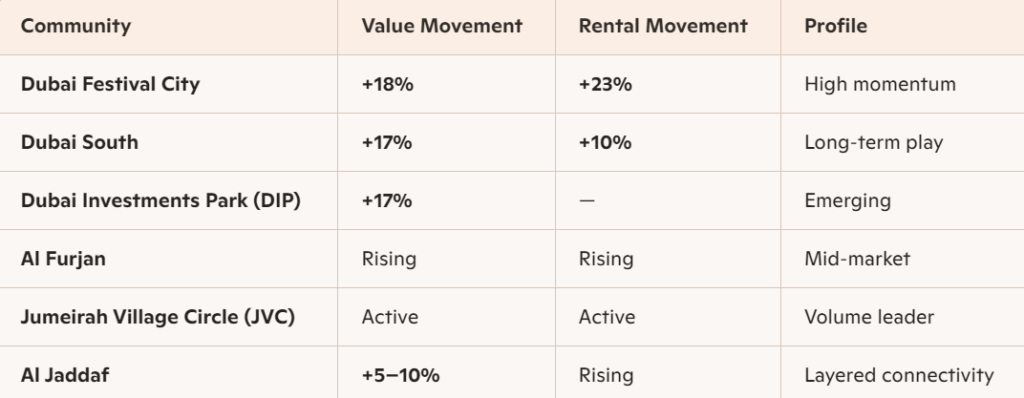
Community Insights: Value Movement, Rental Trends & Market Profile
Etihad Rail is already influencing buyer interest and rental activity across several Dubai communities. Based on current market patterns, here is a clear snapshot of how key areas are performing:
What These Trends Mean for Each Community
Dubai Festival City
A high‑momentum community with strong family demand.
Large layouts, waterfront living, and central positioning are driving both value and rental growth.
Dubai South
A long‑term growth zone benefiting from airport expansion, new master communities, and future rail connectivity.
Ideal for buyers seeking affordability with long‑term upside.
Dubai Investments Park (DIP)
An emerging area gaining attention due to improving infrastructure and competitive pricing.
Appeals to residents looking for value and accessibility.
Al Furjan
A consistent mid-market performer with strong connectivity and metro access.
Both sales and rentals are rising steadily.
Jumeirah Village Circle (JVC)
One of Dubai’s highest‑activity communities.
Strong rental yields and high transaction volume make it a favorite among investors.
Al Jaddaf
A centrally located community with layered connectivity (Metro + future rail influence).
Steady value growth and rising rental demand reflect its strategic position.
How Etihad Rail Will Change Living Patterns
Etihad Rail is not just a transport upgrade; it is a shift in how people will choose where to live, work, and invest. By connecting major cities across the UAE, the network will make daily movement faster, easier, and more predictable. This level of national connectivity will reshape residential demand, especially in communities positioned along or near the new rail corridors. As travel times shrink, people will have more flexibility in choosing homes based on lifestyle rather than distance.
Key Shifts
- Inter-emirate commuting will become normal
- Dubai will remain the premium residential hub
- Mid‑market communities will grow faster
- Rental demand will increase across connected areas
How Buyers Can Position Themselves Before Services Go Live
Etihad Rail is entering its final phase before opening to the public, and this period is often where the strongest opportunities appear. As the network prepares to launch passenger services, confidence in connected communities is rising, and early movement is already visible in both sales and rentals. Buyers who position themselves now are not reacting to the market they are getting ahead of it.
This is the stage where demand starts building, but prices have not yet fully adjusted to the long‑term impact of national connectivity. For many investors, this window becomes the difference between buying at the right time and buying after the market has already shifted.
Smart Buyer Tips
Choose properties close to future stations
- Homes within walking distance of confirmed or expected stations tend to see stronger and more durable appreciation.
Look for communities with multiple transport options
- Areas that combine Rail + Metro + major road access offer better long‑term value and attract a wider tenant base.
Consider off‑plan projects in rail corridors
- Off‑plan can capture future value at today’s pricing, especially in communities where demand is expected to rise after launch.
Focus on areas with strong rental yields
- Rail‑connected zones often see higher occupancy and faster leasing cycles, supporting a solid income strategy.
Check developer reputation and building quality
- Not every building near a rail line benefits equally — quality, layout, and maintenance standards still determine long‑term performance.
Long‑Term Outlook for Dubai’s Residential Market
Etihad Rail is set to reshape how people move across the UAE, and Dubai will sit at the center of this shift. As national connectivity improves, the city becomes even more attractive for residents who want access to multiple emirates without giving up Dubai’s lifestyle, amenities, or job market. This creates a long‑term demand cycle that benefits both end‑users and investors.
Many investors are also exploring off-plan properties in Dubai to secure early pricing advantages in rail-connected zones.
This will lead to:
Higher long‑term demand
Stronger rental market
More buyers from other emirates
Stable price growth in mid‑market communities
Premium retention in central Dubai
Final Thoughts
Every major infrastructure project in Dubai’s history has created value for those who understood its implications early. Etihad Rail is no different. With the 2026 passenger launch approaching, the window for early positioning is open but not indefinitely. As the network moves closer to full operation, the market will gradually shift from anticipation to active demand, especially in communities with direct or layered connectivity.
FAQs
Etihad Rail is the UAE’s national railway network connecting major cities and communities across the country.
Passenger services are expected to begin in 2026.
Homes near future stations are already seeing early demand and are expected to appreciate further after launch.
Dubai Festival City, Dubai South, DIP, Al Furjan, JVC, and Al Jaddaf show the strongest early activity.
Yes, demand is rising, but prices have not fully adjusted yet.
Yes, it will reduce travel times and make inter‑emirate commuting more convenient.
Rental demand is expected to increase in communities with direct or layered connectivity.
Proximity to stations, strong yields, good transport links, off‑plan options, and reputable developers.




 WhatsApp